Warden — system architecture
An authorization gateway for a Travel & Expense agent fleet. Every tool call an agent makes is intercepted, checked against spend policy by a deterministic guardrail and a tiered Gemma → Gemini review, then allowed, blocked, or escalated — before it executes, not after Finance finds out from the statement.
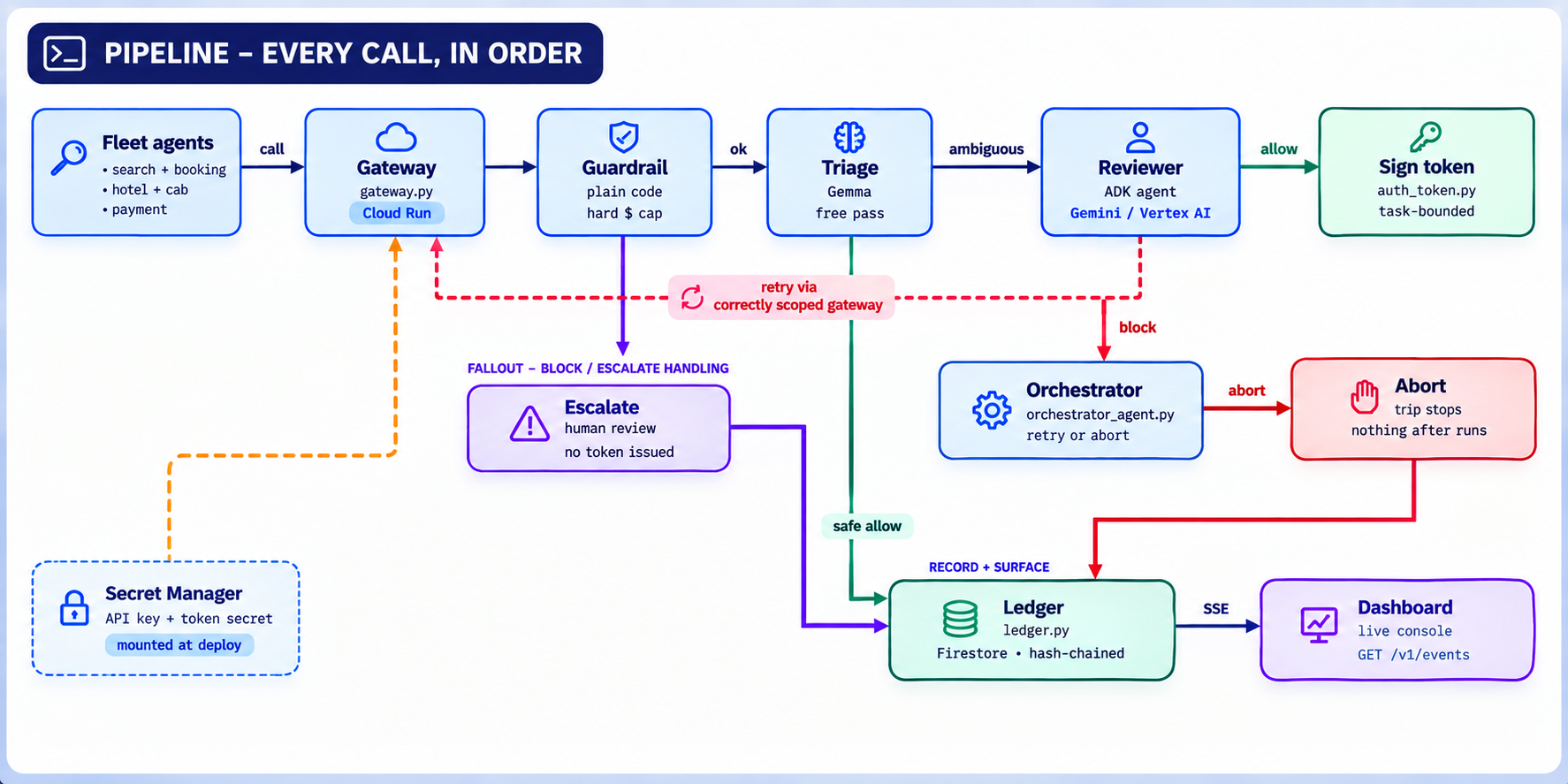
One call, three ways to be cleared — and one way to recover
Most calls never reach a model at all. A hard numeric rule is checked in plain code first; a cheap Gemma pass clears the plainly-obvious rest for free; only genuinely ambiguous calls reach the ADK reviewer. When the reviewer blocks a call, the trip doesn't just stop — an orchestrator agent decides whether to retry it through the agent actually scoped for it, live, per call.
What's used, and what for
The Fortified Enterprise Fleet track names specific infrastructure pieces an enterprise agent fleet needs. Every row below is a piece actually running in this repo, not a description matched to a name — file, package, and how it was verified.
| Named component | Used for | Warden file | Google package / tech |
|---|---|---|---|
| Agent Gateway | Unified routing + policy enforcement — every fleet call passes through one place | gateway.py |
Cloud Run · calls google-adk/google-genai |
| Agent Registry | Publishes each agent's declared scope & spend caps for lookup at call time | registry.py |
google.cloud.firestore |
| Agent Runtime | Runs a whole trip asynchronously in the background, not blocking the request | orchestrator.py |
FastAPI BackgroundTasks · google.adk.runners.InMemoryRunner |
| Model Armor | Inline prompt/response screening on the reviewer's judgment calls | reviewer_agent.py |
google.genai.types.ModelArmorConfig, via Vertex AI |
| Agent Identity | Zero-trust, per-agent cryptographic identity for access control & audit | agent_engine/deploy_reviewer.py |
vertexai.agent_engines · deployed resource's own dedicated IAM service account |
| Memory Bank | Persistent context for one agent across sessions, not just one call | same Agent Engine deployment | auto-provisioned contextSpec.memoryBankConfig |
| Agent Observability | Audit trail + live reasoning-chain trace for every decision | ledger.py + events.py |
google.cloud.firestore (ledger) · OTel configured, not confirmed exported |
Same agent code, three swappable backends
The Reviewer and Orchestrator are defined once — same ADK
Agent, same instruction. MODEL_BACKEND in
.env decides which model actually answers, with no
other code change. Proven locally before ever touching the cloud.
Same agent definition, two hosting targets — one grants a real identity
The reviewer's code doesn't change between these two — only where it runs. In-process on Cloud Run (what's actually deployed) it runs as the default compute service account, with nothing persisting between calls. Deployed once to Vertex AI Agent Engine instead, the resource gets a dedicated cryptographic identity and cross-session memory automatically — verified by reading the deployed resource's own spec, not the marketing description.
spec.effectiveIdentity came back as a dedicated
...-aiplatform-re.iam.gserviceaccount.com service
account (not the shared default), and
contextSpec.memoryBankConfig was present without
having been requested — Memory Bank came from choosing this
hosting target, not a separate integration. Queried it live with
the same scope-violation scenario the whole demo is built around
and got the correct BLOCK decision back. Deleted
again immediately after — Agent Engine doesn't share Cloud Run's
scale-to-zero cost profile.
Same gateway, two different breaches, two different mechanisms
Not two hypotheticals — these are the exact calls
demo/trips.py and demo/scopes.py make on
every real run. Same Gateway entry point both times; what differs
is which layer actually catches it, and what happens next.